

Deborah Lehr
Nature's Ledger





 Nature’s Ledger explores how business and conservation can work together for a sustainable and prosperous future. Host Deborah Lehr, Vice Chairman and Executive Director of the Paulson Institute, speaks with inspiring guests to spotlight people, projects, and solutions that prove nature is an asset we can’t afford to lose. Grounded in the belief that valuing nature is key to resilient economies, the podcast shares bold ideas and real-world actions to regenerate the planet.
Valuing Nature in the Global Economy: From Risk to Opportunity
Deborah Lehr welcomes Dr. Mahmoud Mohieldin, United Nations Special Envoy on Financing the 2030 Sustainable Development Agenda, to the podcast to discuss the fundamental questions shaping the future of development and global finance: How do we properly value nature in the economy, and what happens when we fail to do so?
Dr. Mahmoud Mohieldin, a leading global voice on sustainable development and climate finance, also shares insights from his latest book, Policy-Driven Climate and Development Finance. Edited by Dr. Mohieldin and authored by 38 experts from global, regional, and national institutions, the book argues that current climate and development finance flows remain insufficient, inefficient, and inequitable, and that a new, policy-driven framework is urgently needed. One that reforms institutions, standards, and practices to mobilize capital more effectively, equitably, and at scale.
Drawing on decades of experience across government, multilateral institutions, and global finance, Dr. Mohieldin examines how policy-led finance can unlock climate action, sustainable development, and nature-positive outcomes.

Can AI Help Secure Legal Rights for Whales?
Whales have immense ecological and economic value. They store and move carbon. They feed and fertilize oceans. They influence entire ecosystems. And yet, many species are struggling to survive and thrive. Can decoding the language of whales help us protect them?
To answer this question and more, Deborah Lehr welcomes David Gruber, Founder & President of Project CETI and National Geographic Explorer, to Nature’s Ledger. They discuss his work analyzing whale communication using AI and bioacoustics and how we can better understand non-human intelligence and potentially reshape how law, policy, and society think about the protection of marine life.
They also cover Gruber’s love of nature and how it started and continues as a journey to understand different life forms, the interdisciplinary elements of his work and how he and his team bring together biology, oceanography, and technology, and finally what gives him hope as someone who is studying climate change and whales.
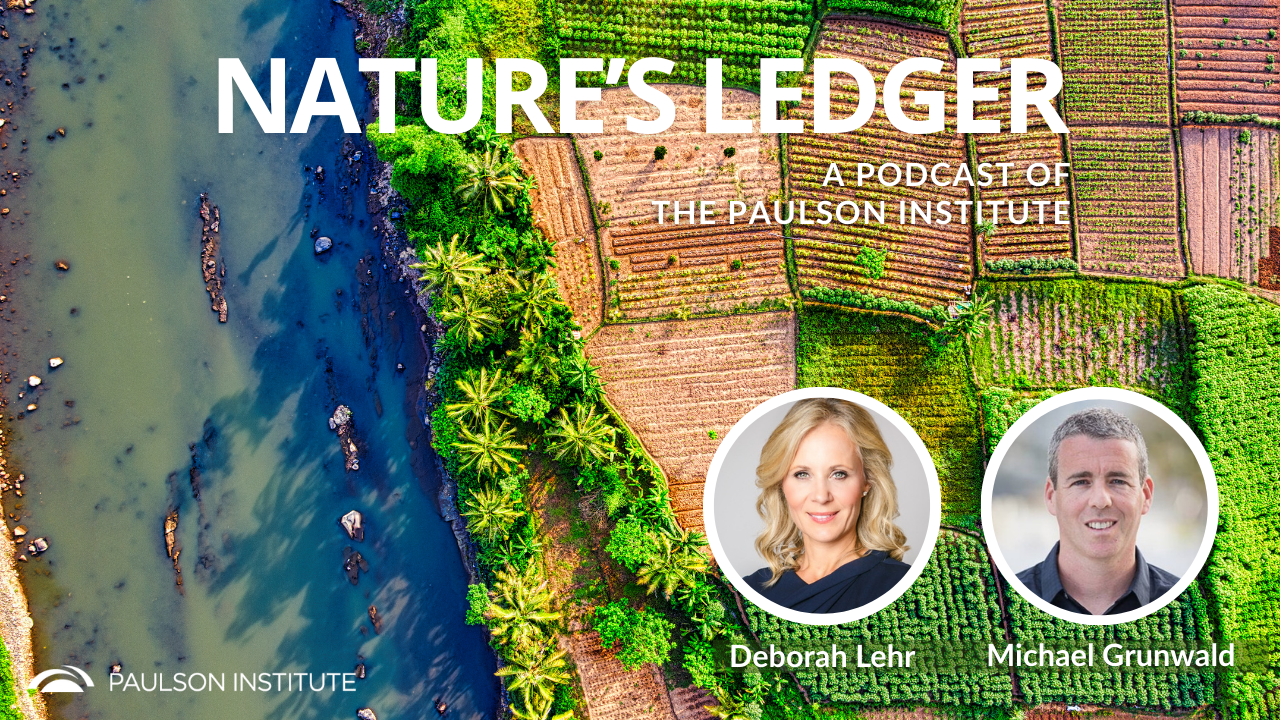
Is the Global Food System Destroying the Planet with Michael Grunwald
Can we feed the world in ways that don’t harm nature or disrupt economic stability?
This is the question Deborah Lehr is tackling on the latest episode of Nature’s Ledger. She welcomes award-winning journalist and New York Times bestselling author Michael Grunwald for a conversation on the impact of the global food system on the environment. They cover his latest book, We Are Eating the Earth, how we can produce more food for a growing population while using less land, and how agriculture affects water, climate, and biodiversity. They also discuss how our diets affect the planet, the political power behind the agricultural industry, and potential solutions to protect nature.
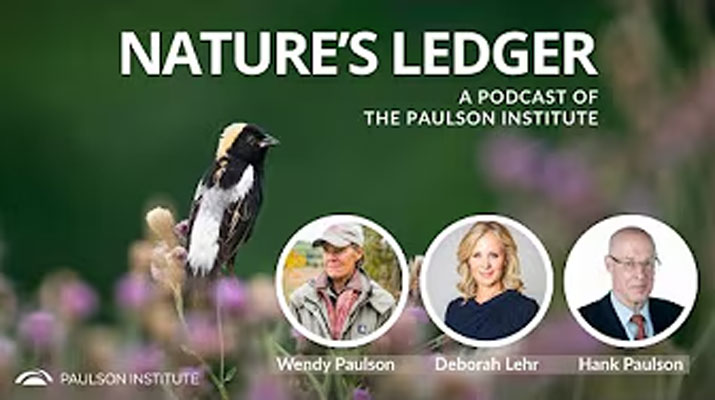
Love of Nature in Action with Hank and Wendy Paulson
On the inaugural episode of Nature’s Ledger, Hank Paulson, Chairman of the Paulson Institute and 74th Secretary of the Treasury, and Wendy Paulson, Vice Chairman of the Paulson Institute and Chairman of the Bobolink Foundation, join Deborah Lehr, Vice Chairman and Executive Director of the Paulson Institute, to discuss how their love of nature began, integrating their professional skills and connections with their conservation efforts, and how they work together. They share their advice for anyone wanting to make a difference in protecting nature and also what gives them hope amidst pessimism and bad news. Hank also touches on valuing nature and the biodiversity financing gap.
Hank also touches on valuing nature and the biodiversity financing gap. Read more in the Financing Nature interim report.