

Hank Paulson
Straight Talk with Hank Paulson




 From growing up in the Midwest to leading Goldman Sachs and then serving his country as Treasury Secretary, Hank Paulson offers a unique point of view and a life experience unlike many Americans. With Straight Talk, Hank brings this experience to his conversations with the world’s prominent leaders and thinkers, exchanging a lifetime of stories and lessons from both the private and public sectors. Each episode reveals compelling viewpoints, topical discussion, and behind-the-scenes stories.
 Featured Episode
David Wallace-Wells on Journalism, the Climate Crisis, and Green Recovery
Rahm Emanuel on Local Politics, US-Japan, and Washington
Hank welcomes Rahm Emanuel (31st US Ambassador to Japan, 55th Mayor of Chicago, and former White House Chief of Staff) to the podcast to discuss his upbringing and how it shaped his interests and values, his start in local politics, working in Washington, and the difference between working in the Clinton and Obama administrations. He delves into his tenure as Mayor of Chicago, the US-Japan relationship, and the goals of the alliance.
Melissa Kearney on Social Mobility and Divergent Family Structure
Hank welcomes Melissa Kearney (Director of The Aspen Economic Strategy Group and Economics Professor at the University of Maryland) to the podcast to discuss her new book, The Two-Parent Privilege, which explores the rise of single-parent households and the benefits two-parent homes provide for children. Kearney looks at widening inequality, eroding social mobility, divergent family structure, and why marriage is so important for children. They talk about potentially controversial takes in the book, the social and economic reasons for declining marriage rates, and the importance of investing in America’s youth.
Melissa Kearney previously appeared on the second season of Straight Talk with Hank Paulson, stream that episode here.
Hillary Clinton on American Democracy, US-China, & Education
Hillary Clinton (67th US Secretary of State and former US Senator) joins Hank on Straight Talk to discuss the state of American democracy, political polarization, and US-China relations. She shares insights into leadership and civic responsibility, America’s role in the world, her advice for young people, and the importance of education in navigating a rapidly changing world.
Bob Rubin on Leadership, the Economy, and Politics Today
Hank welcomes Bob Rubin (Chairman Emeritus, Council on Foreign Relations and 70th US Treasury Secretary) back to the podcast to discuss his new book The Yellow Pad: Making Better Decisions in an Uncertain World. Rubin shares his insights on decision-making, the importance of free expression and unfettered discussion, and leadership. They dive into climate policy, the state of politics today, and America’s current fiscal situation.
George W. Bush on PEPFAR, Politics, and Leadership
The Bush Administration, National Security, and US-China with Stephen Hadley
Hank welcomes Stephen Hadley (Principal at Rice, Hadley, Gates & Manuel LLC and Former Assistant to the President for National Security Affairs) to the podcast to discuss his new book Hand-Off and the Bush Administration’s accomplishments and missteps. He shares insights into China in the Bush era and the China of today, and America’s trade policy.
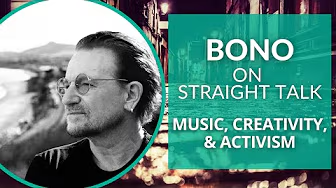
U2’s Bono Talks Music, Creativity, & Activism
On the heels of releasing his book, Surrender, Bono (Lead Singer, U2 and Cofounder, ONE and (RED)) joins Hank on Straight Talk to discuss creating award-winning music with U2 while advocating for causes affecting the world’s most vulnerable people. From advocating for AIDS relief in Africa and fighting poverty to addressing climate change and the importance of inclusive growth, Bono talks about how vital it is to surround yourself with a diversity of ideas and people in order to tackle complex issues. Listen in as he shares insights into his activism, the radical center, prayer, how he thinks about creativity, and how Dublin shaped him.
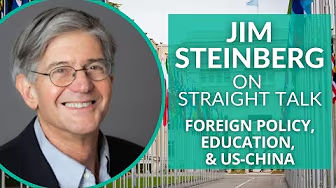
Foreign Policy, Education, & US-China with Jim Steinberg
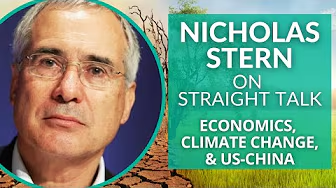
Economics, Climate Change, & US-China with Nicholas Stern
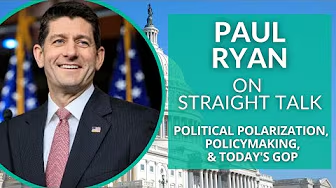
Paul Ryan on Political Polarization, Policymaking, & Today’s GOP
Minouche Shafik on Education, the Green Economy, & Climate Change
Minouche Shafik (Director, London School of Economics) joins Hank on Straight Talk to discuss her philosophy of education and her vision for the London School of Economics, the role the IMF and Central Banks should play in the transition to a green economy, and her acclaimed book. She shares insights into growing up in the American South, economics and public policy, and how governments can navigate economic growth, national security, and climate change.
Biodiversity, Conservation, & Nature with Cristián Samper
Cristián Samper (Managing Director, Bezos Earth Fund and tropical biologist) joins Hank on Straight Talk to discuss his upbringing in Colombia and the importance of the country in preserving biodiversity, how he developed his connection with nature, COP 15 and important agenda items and challenges. He also shares insights into the approach and priorities of the Bezos Earth Fund, tipping points in vital ecosystems, biodiversity financing gap, and creating the next generation of conservationists.
Admiral Mike Mullen on US-China Relations, Foreign Policy, & Terrorism & Nuclear Risks
Admiral Mike Mullen (17th Chairman of the Joint Chiefs of Staff and retired US Navy Admiral) joins Hank on Straight Talk to discuss how his distinguished career in the Navy unfolded, the role of Chairman of the Joint Chiefs of Staff, and advising both presidents Bush and Obama. He assesses the status of the war in Ukraine. He shares insights into nuclear risks and the threat of nuclear proliferation, US-China relations, executing the plans that led to the death of Osama Bin Laden, and current terrorist threats to the US.
David Sibley on Birds, Birding, & the Biodiversity Crisis
David Sibley (Author, Illustrator, and Ornithologist) joins Hank on Straight Talk to discuss birding, bird collisions and the impact of cats on bird populations, and the biodiversity crisis. He shares insights into his love of drawing, the Sibley Guide to Birds and how the guide works, and his advice for young birders.
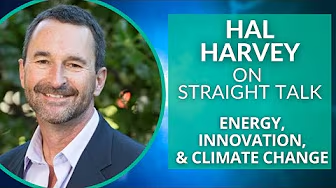
Energy Innovation, Environmentalism, & Tackling the Climate Crisis with Hal Harvey
Hank welcomes Hal Harvey (Chief Executive Officer of Energy Innovation) to the podcast to discuss the influence of his mother’s environmentalism on his career, his knack for innovation in the energy space, and his new book, The Big Fix. He shares insights into what he’s working on and his goals for Energy Innovation, how we can keep from losing ground in the fight against climate change as we navigate the current energy crisis, and a path forward for US-China cooperation on tackling climate change.
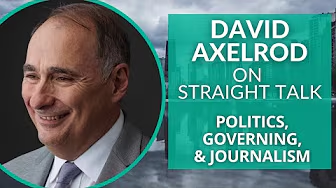
David Axelrod on Politics, Governing & Campaigning with Obama, & Journalism
Hank welcomes David Axelrod (Director, University of Chicago Institute of Politics and CNN Senior Political Commentator) to Straight Talk to discuss his experience in journalism, how he met Barack Obama and was inspired to work on his campaigns, and the shift from advising in politics to governing. He shared insights into Obama’s historic presidential run, navigating the financial crisis, polarity and the state of US democracy, and the impact of social media on politics and division in our country.
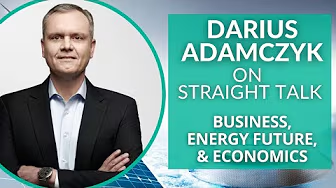
Energy, Economics, & Innovation with Darius Adamczyk
Darius Adamczyk (Chief Executive Officer of Honeywell) joins Hank on the podcast to discuss Honeywell and its role in the planet’s energy future, data architecture, and the economic, business, and policy aspects of US-China relations. He shares insights on operating a multinational business in an increasingly unpredictable political landscape, creating an environment for innovation, and his management principles.
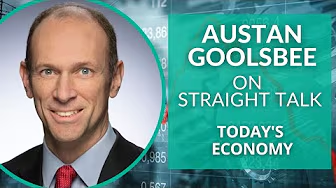
Economics, Inflation, & Interest Rates with Austan Goolsbee
Walter Isaacson on Writing, Political Polarization, & Climate Innovation
Technology, Data Security, & the Digital Economy with Samm Sacks
US-China Competition, Economic Interdepence, & Diplomacy with Evan Medeiros
Evan Medeiros (Professor and Penner Chair in Asian Studies (China), Georgetown University) joins Hank on Straight Talk to discuss US-China relations and balancing the intensifying competition among world powers with economic interdependence. He shares insights on the rapid decoupling between the West and Russia and potential impacts on the US-China relationship, expectations for China’s 20th Party Congress, and America’s economic and diplomatic engagement in the Indo-Pacific.
Henry Kissinger on Politics, US Diplomacy, & Tech & AI
Henry Kissinger (Chairman of Kissinger Associates, Inc. and 56th Secretary of State) joins Hank on Straight Talk to discuss how coming to America after fleeing Nazi Germany shaped his worldview, getting his start in politics, and working with the world’s most consequential leaders, something he delves into in his latest book. He shares insights into US-China relations, US diplomacy today, and technology and the challenges and opportunities emerging from AI.
Public Service, Economics, & Crisis Management with Neel Kashkari
Social Impact Investing & the Finance Industry with Jim Coulter
Hank welcomes Jim Coulter (Executive Chairman and Director, TPG) to Straight Talk to discuss private equity performance, the evolution of the finance industry and his career, leading on climate and social impact investing, and lessons from the global financial crisis. He shares his principles for successful business leadership and how his early job running his family’s farm shaped him.
Food Security, Climate, and Agriculture with Sara Menker
Jason Furman on Economics, Inflation, & Trade
Hank welcomes Jason Furman (Professor of Practice at Harvard University and former Chairman, Council of Economic Advisors) to discuss today’s economy, inflation, and how we got here. Furman shares his insights into the leadership styles of presidents Clinton and Obama, America’s role as a global leader, and trade policy.
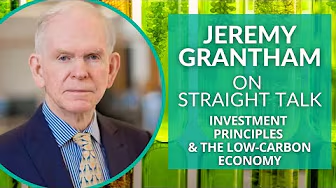
Jeremy Grantham on Investment Principles and the Low-Carbon Economy
Jeremy Grantham, CBE (Co-Founder and Long-Term Investment Strategist of Grantham, Mayo, & van Otterloo) joins Hank Paulson on Straight Talk to discuss growing up in the UK in the backdrop of World War II, starting his own investment firm, and making sense of today’s market. He shares insights into combining philanthropy with his investment principles to accelerate the transition to a low-carbon economy, greening the energy system, and the need for capitalism reform to increase equity, growth, and advancement.
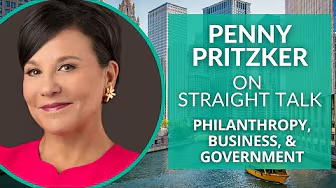
Penny Pritzker on Chicago, Philanthropy, Business, & Government
Hank welcomes Penny Pritzker (Founder and chairman of PSP Partners and 38th US Secretary of Commerce) to Straight Talk. They discuss driving change in business and government, learning entrepreneurship and philanthropy, and her family’s roots in Ukraine. She shares insights into how Chicago shaped her, succeeding in business and serving in government, and her principles of leadership.
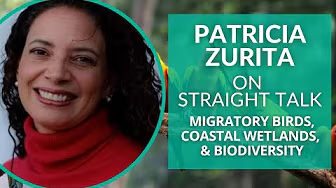
Birds, Wetlands, Conservation, & Biodiversity with Patricia Zurita
Patricia Zurita (CEO of BirdLife International) joins Hank to discuss efforts to help China protect and preserve coastal wetlands, migratory birds, the importance of women leaders in the conservation movement, and needing more champions of nature. She shares insights on nature’s solutions to humanity’s problems, BirdLife International and global cooperation, and the need to tackle the biodiversity and climate crises in tandem.
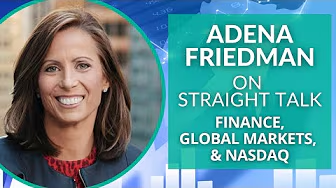
Finance, Technology, & Global Markets with Adena Friedman
Adena Friedman (President and Chief Executive Officer of Nasdaq) joins Hank on Straight Talk to discuss financial changes shaping global markets, how Nasdaq has evolved, anti-financial crime technology, and the cloud as the next generation of markets. She shares insights into what led her to Nasdaq and her principles for leadership in the fast-moving world of finance.
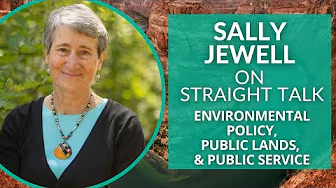
Nature, National Parks, & Public Service with Sally Jewell
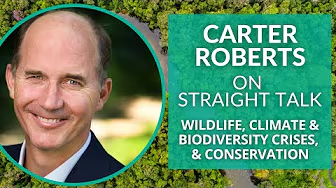
Biodiversity, Conservation, & the World Wildlife Fund with Carter Roberts
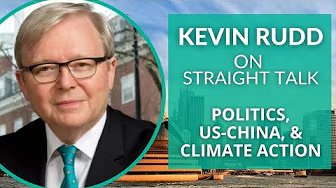
Kevin Rudd on Political Division in the US, US-China Conflict, and Climate Action
Hank welcomes Kevin Rudd (26th Prime Minister of Australia and President of the Asia Society Policy Institute) to the podcast to discuss what motivated him to write his newest book, The Avoidable War, managed strategic competition and building strategic trust, China-Russia relations and the impact of the latter’s invasion of Ukraine, and US-China and the potential for decoupling or establishing a stable relationship.
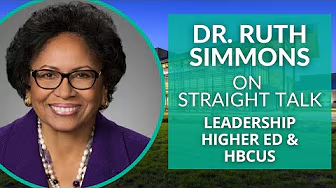
Leadership, Higher Education, and the Importance of HBCUs with Dr. Ruth Simmons
Dr. Ruth Simmons (President, Prairie View A&M University) joins Hank Paulson on the podcast to share the obstacles she encountered early in life, her parents’ lives as sharecroppers, and how they empowered her to get an education. Simmons discusses higher ed and the important work of HBCUs, her views on leadership, and the need to keep learning and be open to what people have to teach.
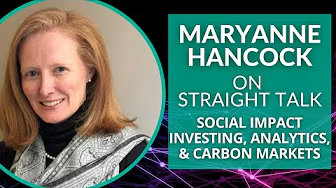
ESG Investing, Carbon Markets, and Impact Analytics with Maryanne Hancock
Maryanne Hancock (CEO, Y Analytics) joins Hank on Straight Talk to discuss social impact investing, the trajectory of ESG investing, breaking new ground in impact analytics and how Y Analytics creates decision tools, and carbon markets. She shares insights into the formative example of her parents’ social justice work, learning from Justice Kagan, and how her work at McKinsey shaped her view of the good the private sector can do in the world.
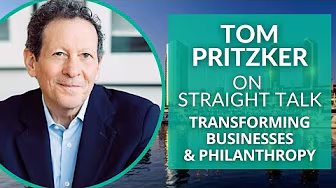
Tom Pritzker on Transforming Hyatt Hotels, Philanthropy, and Doing Business in China
Hank welcomes Tom Pritzker (Executive Chairman of Hyatt Hotels) to Straight Talk. They discuss Pritzker’s wide-ranging interests from business to 11th-century Himalayan history, his role transforming Hyatt Hotels, and doing business in China. Pritzker shares his insights on the importance of philanthropy to his family, practicing empathy, and finding a “North Star” to lead through challenging situations.
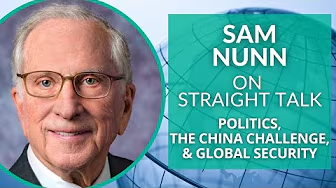
Politics, the China Challenge, and the Nuclear Threat Initiative with Sam Nunn
Hank welcomes Sam Nunn (Co-founder of NTI and former US Senator, Georgia) to Straight Talk. Nunn talks about his upbringing in Georgia and what inspired him to get into politics. He shares insights on the important role of the Senate’s Armed Services Committee, the China challenge and potential areas of cooperation for the US and China, and the work of Nuclear Threat Initiative. They also discuss Russia’s invasion of Ukraine and the ensuing humanitarian crisis and geopolitical implications.
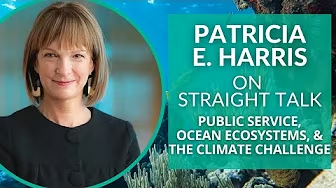
Bloomberg Philanthropies, Ocean Conservation, and Climate Action with Patricia E. Harris
Patricia Harris (CEO of Bloomberg Philanthropies) joins Hank on Straight Talk to discuss what inspired her interest in public service, the importance of having a good team, and scuba diving and how it strengthened her passion for protecting ocean ecosystems. She shares what she’s most proud of from her years in New York City government, how she views the climate challenge, and what Bloomberg Philanthropies is doing to tackle it.
Ray Dalio on His Start in Finance, Global Order, and Monetary Policy
Ray Dalio, Founder of Bridgewater Associates, joins Hank to discuss what motivated him to write his latest book where he looks at history to help predict the future and the three modern phenomena to watch: social dysfunction, polarization, and the rise of China. He also shares his insights on the current economic situation, US-China relations, and the most important principles for our world leaders.
Larry Fink on Capitol Markets, BlackRock, and Private Sector Action on Climate Change
Hank welcomes Larry Fink (Co-Founder, Chairman, and CEO of BlackRock) to Straight Talk to discuss carbon, private sector action on climate change and the need for governments to step up. He also talks about his interest in capital markets, the genesis of BlackRock, and how they are addressing greenwashing.
Evan Osnos on Politics, Journalism, and Social Media and Tech Leaders
Evan Osnos (Staff Writer, The New Yorker and author) joins Hank Paulson on Straight Talk to share what inspired him to be a journalist, how he views the China challenge moving forward, as well as social media and the need for tech leaders to ensure their platforms are tools for good. They also discuss US-China relations, the power of tech and how it functions in politics, and Osnos’ new book Wildland.
John Podesta on Divisions in Politics, Policy, and US-China Relations
Hank welcomes John Podesta (Former White House Chief of Staff and Founder, Center for American Progress and the Washington Center for Equitable Growth) to Straight Talk. They discuss division in politics, the role of think tanks in the policy world, the risks and challenges of climate change, and the biodiversity crisis. Podesta shares insights into how politics has changed since he first headed to Capitol Hill in the 80s, his theory of change, and strategic competition between the US and China.
Larry Summers on the Economy and the Role of Government, China, and Higher Ed
US-China Tech Frictions, STEM, and Public Service with Anja Manuel
Sir Partha Dasgupta on Economics, the Biodiversity Crisis, and Valuing Nature
Gillian Tett on Journalism, Economics, and Covering Climate Change
Hank Paulson welcomes Gillian Tett (Moral Money Co-Founder and Chair of the Editorial Board and Editor-at-Large, US of the Financial Times) to the podcast to talk about what drew her to anthropology, her transition to journalism and economics, covering climate change and green finance, and her new book.
Jerry Yang on Regulation of Big Tech, Yahoo, and US-China Relations
Jerry Yang (Founder of AME Cloud Ventures and Co-Founder of Yahoo) joins Hank on Straight Talk to discuss regulating big tech, the trajectory of US-China relations, and climate change and sustainability. He also talks about the founding of Yahoo, as well as anti-Asian violence and hate speech and the mission and work of the newly founded Asian American Foundation.
US-China Competition, Green Finance, and Climate Change with Deborah Lehr
Deborah Lehr, Paulson Institute Vice Chairman and Executive Director, joins Straight Talk with Hank Paulson to discuss her experience studying in China in the 80s, working on economic relations with China and the country’s accession to the WTO, combating global looting via the Antiquities Coalition, and her advocacy for a career of service. She shares insights on US-China competition, China’s expanding role in the Middle East, and how green finance is key to fighting climate change.
Ernest Moniz on Energy, Policy, and Climate Change
Hank welcomes Ernest Moniz (13th US Secretary of Energy and President and CEO of Energy Futures Initiative) to Straight Talk to discuss the intersection of energy, climate, science, and policy. Moniz shares insights on mentorship and STEM education, what it takes to succeed in Washington, how carbon capture can help the world reach net zero emissions, nuclear energy’s potential, serving as a key architect of the Paris Agreement, the upcoming Glasgow climate summit, and his case for climate optimism.
Khaldoon Khalifa Al Mubarak on Global Investing, the United Arab Emirates, and Climate Change
Khaldoon Khalifa Al Mubarak, Managing Director and Group CEO of Mubadala, joins Hank on Straight Talk to discuss how UAE has developed over its first 50 years and where the country is headed in the next 50, investing in the future of the UAE through Mubadala, how UAE is working to meet the climate change threat, the strength of the US-UAE relationship and how UAE is approaching its relationship with China, and what he’s learned while leading Manchester City Football Club.
Climate Policy, Climate Planning, and Climate Optimism with Kate Gordon
Kate Gordon (Senior Advisor to Gov. Gavin Newsom & Director, Governor’s Office of Planning & Research) joins Hank on the podcast to discuss her dedication to furthering climate policy, defining climate change as a science problem with a policy solution, the latest developments in California’s climate planning efforts, and her case for climate optimism.
David Wallace-Wells on Journalism, the Climate Crisis, and Green Recovery
Physics, Climate Diplomacy, and Carbon Neutrality with David Keith
Hank welcomes David Keith (Gordon McKay Professor of Applied Physics, Harvard John A. Paulson School of Engineering and Applied Sciences and Professor of Public Policy, Harvard Kennedy School) to Straight Talk to discuss his physics background, how he would define the climate challenge, climate diplomacy and addressing the global governance problem, what is needed to truly achieve carbon neutrality, solar geoengineering, and the next technologies in the energy industry.
Economics, Economic Literacy, and Policy with Melissa Kearney
Melissa Kearney (Director of The Aspen Economic Strategy Group and Economics Professor at University of Maryland) joins Hank Paulson to discuss how she got involved in economics, the economic impact of the pandemic on women, the importance of policy that recognizes children as the future of our country, the mission of the Aspen Institute Economic Strategy Group, and how the US can ensure better economic literacy.

Music, Creativity, and Intellectual Property with Maria Schneider
Hank Paulson welcomes Grammy award winner Maria Schneider (composer, jazz musician, and orchestra leader) to the podcast. She shares insights on writing music and the creative process, building a business in a tough industry. They discuss intellectual property and the free market, their shared passion for birding, and Schneider talks about collaborating with David Bowie.
Higher Education, Free Speech, and Leadership with Robert Zimmer
Robert Zimmer (President, The University of Chicago) joins Hank to discuss leadership that improves an already great institution, creating a healthy environment for free speech, the importance of international talent to higher education and innovation in America, and managing the University through the current pandemic.
The Global Economic System, Trade Policy, and Climate Change with Jennifer Hillman and Daniel Price
Hank is joined by Jennifer Hillman (Senior Fellow, Council on Foreign Relations and Professor, Georgetown Law) and Daniel Price (Managing Director, Rock Creek Global Advisors). They discuss how they started their careers in trade policy, the importance of trade to America’s well-being and standing in the world, how the US can balance China in the international economic system, and how the global trading system could help in the fight against climate change.
Design, Architecture, and Sustainability with Jeanne Gang
Kevin Rudd on US-China Relations, Foreign Policy, & Decoupling
Hank welcomes Kevin Rudd (26th Prime Minister of Australia and President of the Asia Society Policy Institute) to the podcast to discuss how he went from a small town farm in Queensland to a career in foreign service and politics, his perspective on the social and political divisions in the US, advocating for climate action, preventing US-China conflict, and his expert prognosis for the future of China’s ambitions.
Women in STEM, Academia, and Higher Education with Paula Johnson
Paula Johnson, President of Wellesley College, joins Hank Paulson to discuss her mother’s influence on her career, women in STEM and obstacles she’s faced in medicine and academia, the benefits of women’s colleges, her management style, what has driven her throughout her career, and leading Wellesley College amidst the pandemic.
Michael Nutter on Politics, Sustainability, and Social Justice
Michael Nutter (former Mayor of Philadelphia and David N. Dinkins Professor at Columbia University) speaks with Hank about his improbable path to becoming mayor of Philadelphia, how mayors are uniquely qualified to lead on sustainability issues, working with mayors across the US and in China, the national conversation around racial equity and social justice, and the future of cities in a post-COVID society.
Episode 31 was recorded on Friday, November 20, 2020.
Condoleezza Rice on Foreign Policy Priorities, the National Conversation on Race, and Bipartisanship
Condoleezza Rice (Director of the Hoover Institution and 66th Secretary of State) joins Hank Paulson to talk about growing up in Alabama, her love of piano, what’s missing from the national conversation on race, charting a better course toward less divisive politics, and the country’s most pressing foreign policy priorities.
Sherrie Rollins Westin on Early Childhood Education and Sesame Street
Sherrie Rollins Westin (President, Sesame Workshop) joins Hank on the podcast to discuss the mission and ambition that drives her, the global reach and universal appeal of Sesame Street, creating the largest early-childhood intervention in the history of humanitarian response, and her quarantine hobbies.
Ben Bernanke on the Economy, Leading the Federal Reserve, and the Great Recession
Ben Bernanke (Economist and 14th Chair of the Federal Reserve) joins Hank Paulson to discuss his experience leading the Federal Reserve through the Great Recession, what’s needed to overcome the COVID economic crisis, how economic principles apply to baseball, and his advice for aspiring economists.
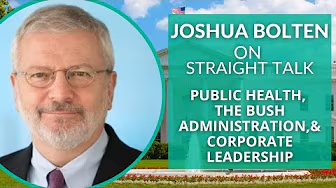
Joshua Bolten on Public Health, the Bush Administration, and Corporate Leadership
Joshua Bolten (President & CEO of Business Roundtable and former White House Chief of Staff) joins Hank Paulson to discuss advice for succeeding as White House Chief of Staff, organizing President Bush’s efforts to improve public health in Africa, what made Bono the most effective lobbyist he’s ever seen, and the new corporate leadership paradigm.
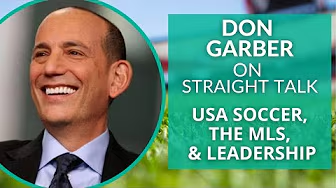
Soccer in the US, the MLS, and Leadership with Don Garber
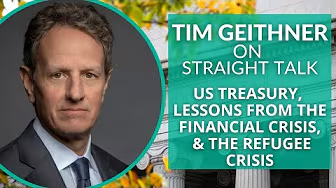
Tim Geithner on the Treasury, Lessons from Past Financial Crises, and the Global Refugee Crisis
Tim Geithner (President, Warburg Pincus and 75th United States Secretary of the Treasury) joins Hank to discuss his experience as US Treasury Secretary, lessons learned from prior financial crises, his efforts to combat the global refugee crisis, and his advice for the incoming Biden Administration.
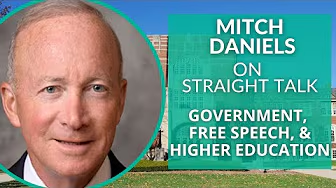
Mitch Daniels on Government, Free Speech, and Higher Education
Mitch Daniels, President of Purdue University and former Governor of Indiana, speaks with Hank about leading an effective state government, how Purdue has kept tuition flat, the importance of free speech in higher education, managing a university during the pandemic, and how to best protect American intellectual property and innovation.
Robert Zoellick on US Trade Policy, the World Bank, and US-China Relations
Robert Zoellick (11th President of the World Bank and Senior Counselor, Brunswick Group) shares insights on how the United States can lead on international trade, the importance of the World Bank in addressing pressing global issues such as climate change, what is needed for an effective US policy toward a rising China, and his recommendations for the incoming Treasury Secretary.
US-China Tech Competition and National Security with Jen Zhu Scott & Paul Triolo
Jen Zhu Scott (Executive Chairman of The Commons Project and Founding Principal of Radian Partners) and Paul Triolo (Geotechnology Head, Eurasia Group and Senior Advisor, MacroPolo) join Hank Paulson to discuss the state of the US-China tech competition, what it means for the future of national security, and what to expect from a Biden administration on technology policy.
Erskine Bowles on the US Economy, Investing, and Politics
Hank speaks with Erskine Bowles, Co-Chair of the Aspen Economic Strategy Group and President Emeritus of the University of North Carolina. Bowles details how he built a successful boutique investment bank, ended up as White House Chief of Staff, and worked across the aisle to balance the budget. He also shares insights on how we can move the US economy forward and delves into what he learned about higher education, drawing from his six years leading the University of North Carolina system.
Bob Rubin on the Treasury, Economic Policy, and Green Recovery
Mario Draghi on the European Central Bank, Economics, and Pandemic Recovery
Mario Draghi, Economist and former President of the European Central Bank, joins Hank to discuss how his upbringing shaped his future in economics, his experience managing the ECB through the financial crisis, and how central banks should approach pandemic recovery.
Bird Conservation, Biodiversity, and Studying Nature with John Fitzpatrick
Hank speaks with John Fitzpatrick, Executive Director of The Cornell Lab of Ornithology. Fitzpatrick details the importance of bird conservation worldwide, what it’s like to discover a new species, how technology is improving our ability to study nature, and what makes him hopeful for the future of biodiversity.
Climate Science and Geoengineering with Ken Caldeira
Ken Caldeira, Senior Scientist (Emeritus) at Carnegie Institution for Science and Senior Advisor (Climate Science) at Gates Ventures, joins Hank Paulson to discuss the latest climate science, how to get policymakers to act on climate change, and how geoengineering may be vital to ensuring a livable planet.
Straight Talk: Henry M. Paulson, Jr. Keynote at Bloomberg New Economy Forum 2020
On Monday, November 16, Hank Paulson, Chairman of the Paulson Institute and 74th US Secretary of the Treasury, addressed the 2020 Bloomberg New Economy Forum. In the speech, Paulson lays out his recommendations for President-elect Biden’s China policy, arguing that competition without unnecessary confrontation should be our goal, because confrontation without effective competition has produced some poor results for the American people. He further recommends that the US pursue a self-interested policy that he terms “targeted reciprocity.”
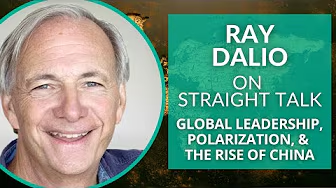
Ray Dalio on Social Dysfunction, Polarization, and the Rise of China
Ray Dalio, Founder of Bridgewater Associates, joins Hank to discuss how he got started in finance, finding opportunity amidst setbacks, his new book, The Changing World Order, and monetary policy in the wake of COVID-19.
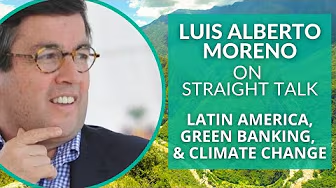
Luis Alberto Moreno on Latin America, Green Banking, and Climate Change
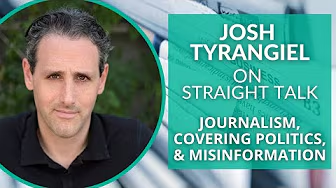
Josh Tyrangiel on Journalism, the Changing Media Landscape, and Misinformation
Hank speaks with journalist and producer Josh Tyrangiel about the evolving media landscape, coverage of the pandemic and the 2020 election, and his new HBO film on cyber warfare and misinformation: The Perfect Weapon.
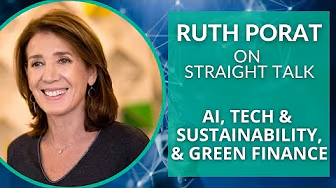
Ruth Porat on AI, Tech and Sustainability, and Green Finance
Ruth Porat (Chief Financial Officer, Alphabet and Google) joins Hank Paulson to discuss tech’s role in sustainability, how Google has responded to COVID and the challenges facing minority-owned businesses, the power of AI to democratize health care, and lessons learned during the 2008 financial crisis.
Charlene Barshefsky on Trade, US-China, and the Economy
Ambassador Charlene Barshefsky, Senior International Partner at WilmerHale and former Chief Trade Negotiator and Principal Trade Policymaker for the United States, joins Hank to discuss the importance of trade in boosting the American economy, what has changed since China was welcomed into the WTO in 2001, and how the US can chart a path forward.
Ginni Rometty on Women in Business and Technology
Hank speaks with business executive and longtime friend Ginni Rometty about what she learned while leading IBM, the role of corporations in addressing the challenges of 2020, and her advice for young women in business.
Politics and US-China Relations with Elizabeth Economy & Michael Pillsbury
Hank welcomes Elizabeth Economy, Senior Fellow at Stanford’s Hoover Institution & Senior Fellow for China Studies at CFR, and Michael Pillsbury, Director for Chinese Strategy at Hudson Institute, to Straight Talk. They discuss how US-China ties have evolved in recent years, Xi Jinping’s ambitions, and where the Sino-American relationship is headed.

Biodiversity and Conservation with Jen Morris & Tom Lovejoy
Hank is joined by Jen Morris and Tom Lovejoy to discuss what inspired their passion for conservation, the need to address the biodiversity crisis, and the launch of Financing Nature, a landmark report from the Paulson Institute, The Nature Conservancy, and Cornell’s Atkinson Center.
Richard Haass on China, International Relations, and Foreign Policy
Hank is joined by Richard Haass, President of the Council on Foreign Relations, on the seventh episode of Straight Talk. They discuss Haass’ latest book, The World: A Brief Introduction, intellectual curiosity, the role of think tanks, America’s global standing in a post-COVID world, and confronting the China challenge.
Cui Tiankai on Diplomacy, Global Governance, and US-China
In this episode, Hank is joined by Cui Tiankai, China’s Ambassador to the US, to discuss what he has learned during his seven years as ambassador, his hopes for the future of US-China relations, and the need for better global governance and cooperation to address the pressing issues of our time.
US-China Relations, the Economy, and the 2020 Election with Graham Allison
Hank speaks with friend and Harvard scholar Graham Allison about geopolitics and US-China relations, including the two countries’ shared interests, economic health, and how the upcoming US election is impacting this important bilateral relationship. They also delve into Thucydides’ Trap.
Lloyd Blankfein on Finance, Global Markets, and Imposter Syndrome
Episode 4 was recorded on Friday, July 10.
Hank is joined by his friend & former colleague Lloyd Blankfein (Senior Chairman, Goldman Sachs) to discuss impostor syndrome, the past, present, and future of markets, as well as economic changes due to the COVID pandemic.

Madeleine Albright on Diplomacy, America’s Role in the World, and US-China
Hank speaks with former US Secretary of State and longtime friend Madeleine Albright. The two former Cabinet members discuss how Sec. Albright became the first woman to serve as US Secretary of State, her new autobiography, how the pandemic has changed America’s role in the world, how to develop a US-China relationship that benefits American interests, and her brief but memorable acting cameos.
US-China Relations, the Economy, and National Security with Ely Ratner & Evan Feigenbaum
In the second episode, Hank speaks with two leading experts on US-China relations, Ely Ratner and Evan Feigenbaum. They discuss a current framework for the US-China relationship, how the US can properly balance national security with economic progress, and where the US can achieve positive results while navigating a number of important conflicts with China.
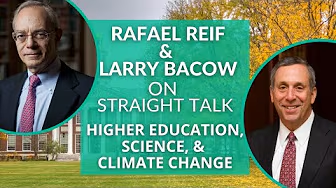
Higher Education, Science, and Climate Change with Larry Bacow & Rafael Reif
The status of many foreign students remains fragile, despite recent lawsuits led by Harvard and MIT challenging a homeland security visa rule that would have forced foreign students to leave or face deportation if they did not attend in-person classes. It was followed quickly by a barrage of lawsuits and an avalanche of public support, leading the government to rescind the rule and refueling a conversation about US competitiveness and treatment of foreign students. In this episode, Hank speaks with the presidents of Harvard and MIT, Larry Bacow and Rafael Reif, on this important issue.